Photo by YSZ
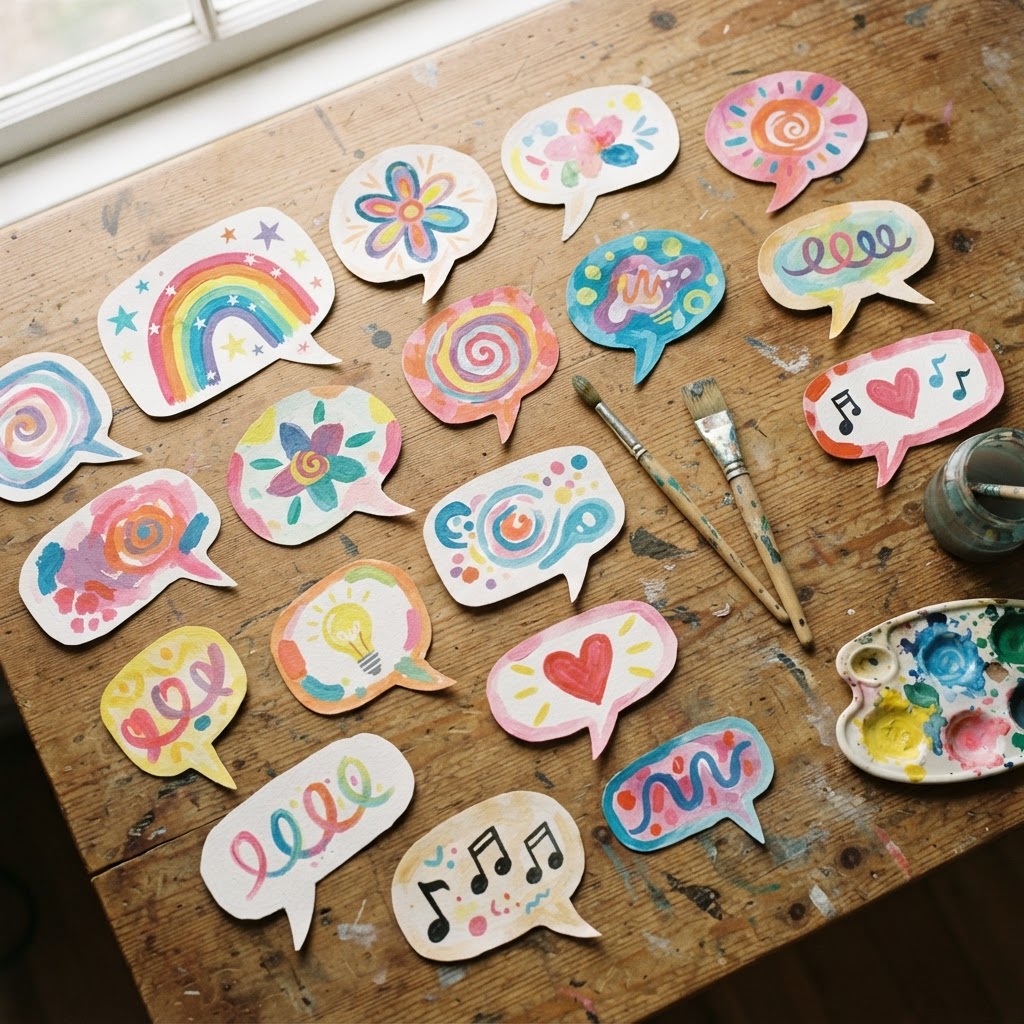
When you're at a festival, the last thing you want is an art activity that needs instructions, supervision, and a clean table. The best festival creativity is the kind a child can start in three seconds, stop whenever they want, and join without having to be "good at art."
That's why we bring stickers. And cardboard. And scraps. Not because they're cheap (though they are) — because they're the most accessible creative materials we know. And they work for everyone — little children, teenagers, young people, and adults.
Why does sticker art work so well at festivals?
Stickers solve the biggest barrier to creativity: the blank page. A blank piece of paper can feel intimidating to anyone, let alone a child in a noisy, overwhelming environment. A sticker sheet says: just pick one.
Here's why stickers are ideal for festival environments:
- No skill barrier: Every child, teen and adult can peel and stick. There's no "right way" to do it.
- Tiny choices: Choosing a colour or shape is a small, controllable act — exactly what an overwhelmed nervous system needs, whatever age it belongs to
- Easy to start and stop: Someone can place one sticker and walk away, or stay for twenty minutes
- No mess: No paint, no glue, no cleanup — just stickers and a surface
- Portable: You can stick them on cardboard, paper, a water bottle, even a hat
Is sticker art just for little children?
No — and this is important. There's an assumption that stickers, cardboard and scribbling are "for kids," and that teenagers and adults should do something more sophisticated. We disagree.
Teenagers and young people at festivals are processing just as much sensory input as younger children — sometimes more, because they're also navigating social pressure, independence, and the expectation to look like they're having a good time. Sitting down with a sheet of stickers and a piece of cardboard gives their nervous system the same gift it gives a five-year-old: a small, controllable, low-stakes action in the middle of chaos.
We've watched teenagers who wandered over "just to see what was happening" end up staying for half an hour, carefully choosing colours and placing them in patterns. We've watched adults who were clearly at the end of their rope sit down, pick up a sticker, and visibly settle. Creativity doesn't card you at the door.
So if you're a teenager reading this: yes, you can come and make a sculpture. If you're an adult who hasn't made anything in years: yes, you too. The sticker sheet doesn't care how old you are.
What are we making at Latitude this year?
We're building shared sculptures. Not individual artworks to take home — collaborative pieces that grow throughout the festival as children, teenagers, young people and adults add their own small contributions.
Here's how it works:
- We bring cardboard, packaging, and found materials — nothing bought new
- People choose stickers, colours, and shapes, and place them wherever they want
- Each piece connects to the one before it — with tape, string, or just proximity
- By the end, there's a sculpture that only exists because every person who stopped by added something
No one has to perform. No one has to explain their piece. The sculpture grows because people keep showing up and placing one small thing — whatever their age.
How do small pieces become one bigger artwork?
This is the bit we love most. A single sticker on a piece of cardboard doesn't look like much. But when twenty people — children, teens, adults — have each placed their stickers, and those pieces are connected, something emerges that no single person planned.
It's a metaphor for connection — and for festivals themselves. A festival isn't one person's experience. It's the accumulation of thousands of small moments, small choices, small acts of showing up. The sculpture makes that visible.
For anyone who finds social interaction tricky — a child, a teenager, an adult — this kind of collaborative making can be a gentler way to be part of something. You don't have to talk. You don't have to perform. You just place your sticker, and your contribution becomes part of the whole.
What materials do we use — and why doesn't it need to be fancy?
Creativity doesn't need a perfect kit. Some of the best festival art we've seen has come from:
- Cardboard boxes and packaging
- Old magazines and scrap paper
- Stickers — the more colours and shapes, the better
- Odd pencil crayons and markers
- Tape, string, and glue
- Recycled bits and pieces — bottle caps, fabric scraps, foil
- Things that don't match
The point isn't the materials. The point is the act of choosing, placing, and contributing. A child who places one bottle cap on a sculpture has made a creative decision. So has a teenager who chooses a colour. So has an adult who picks up a crayon for the first time in years. Every one of those decisions matters.
Is sticker art good for autistic and ADHD children and young people?
For some people, stickers can offer a gentler way in — but we're careful not to say "stickers are good for all autistic/ADHD people," because everyone is different. This applies to children, teenagers and adults alike.
What we can say is that stickers offer things that many people find steadying:
- Clear starting points (pick a sticker, place it)
- No blank-page pressure
- Lots of tiny choices without too many words
- Can be organised, patterned, sorted, or chaotic — whatever the person needs
- Easy to stop and start
- Repetitive and rhythmic — placing sticker after sticker can feel organising, not boring
If your child or teenager loves repetition — placing the same colour sticker in a line, over and over — that's not "boring." That's rhythm. That's familiarity. That's a nervous system finding a pattern it can trust. And if you're an adult who finds yourself doing the same thing? Same answer.
What if my child or teenager just wants to watch?
Watching is participation. Some children and teenagers need to observe an activity for a long time before they're ready to join — and that's completely fine. A young person who stands nearby and watches other people placing stickers is absorbing everything. They're learning the rules, the possibilities, the social rhythm.
We never push anyone to join before they're ready. The sculpture will still be there. The stickers will still be there. When they're ready — if they're ever ready — they'll know what to do.
This is especially important at festivals, where the environment is already intense. For a child, teenager or adult who's processing a lot of sensory input, having a low-pressure creative space where they can enter at their own pace is one of the steadiest things we can offer.
How does this connect to Scribbledeedo?
Everything we do at Scribbledeedo is built around five simple words: scribbles, doodles, colour, shimmies and shimmers.
- Scribbles for starting — no plan, just marks
- Doodles for noticing — letting the hand wander
- Colour for feeling — choosing what matches the inside
- Shimmies for movement — shaking off the buzz
- Shimmers for the glad feeling — when something shifts and settles
At Latitude, you'll see all five. A child who scribbles on cardboard, a teenager who chooses a colour, an adult who places a sticker and then — for a moment — finds a shimmer of connection. That's what we're there for. Whatever your age.
Come and find us at Latitude. And if you're at another festival this summer, pack some stickers and cardboard — you might be surprised what grows, and who joins in. When you get home, read our guide to what happens after the festival — because the transition home can be just as important as the day itself, for everyone.
Try Your Scribbledeedo® Summer Guided Journey
Five playful video lessons for parents and children — free.
Join free