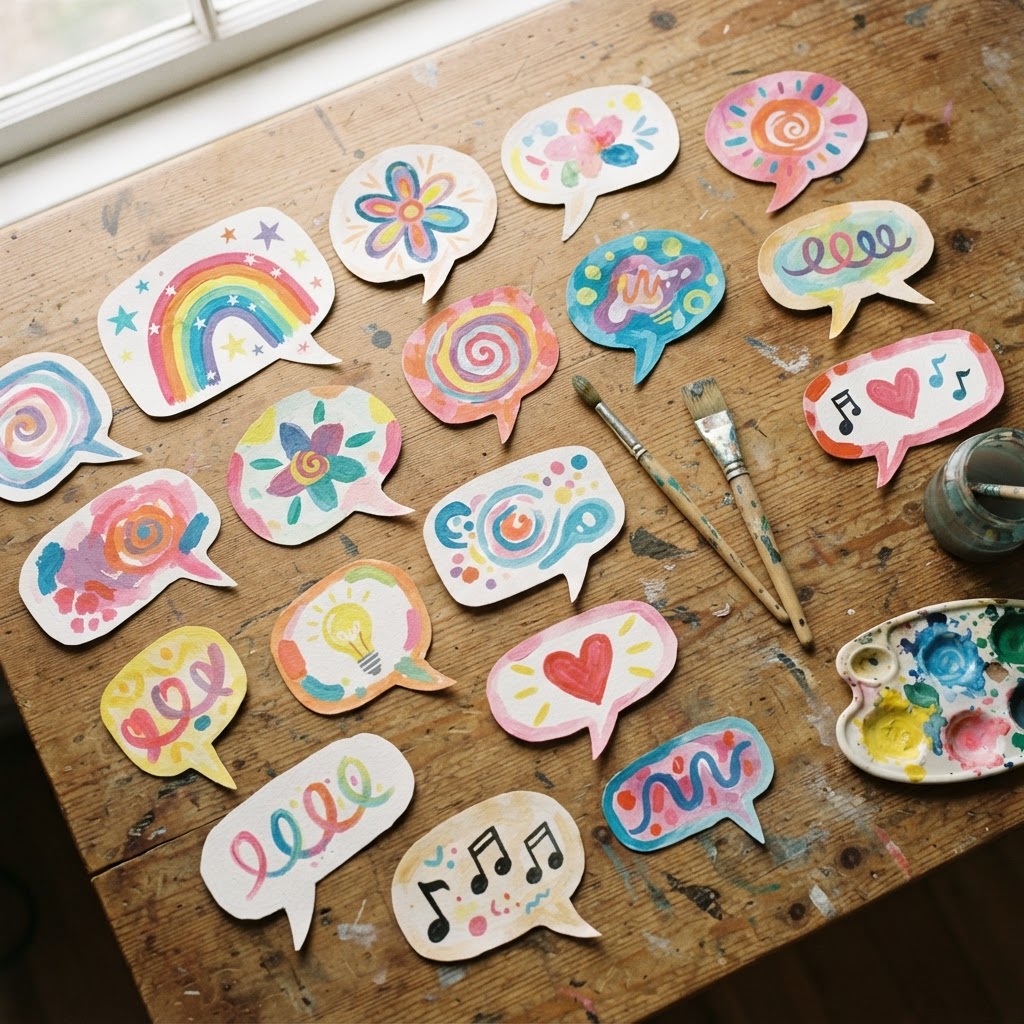
Photography licensed via Unsplash and Scribbledeedo®. All images are curated to align with our children's images policy.
How do non-speaking children communicate?
"Non-speaking" describes children who don't use spoken words, or who use very few — some autistic children, some children with apraxia or other motor differences, some children who speak inconsistently. A common (and harmful) assumption is that non-speaking means non-thinking, non-communicating, or non-feeling. None of that is true.
Non-speaking children have rich inner lives, things to say, and strong desire to connect. They simply need routes other than speech to express them. And creativity is one of the most powerful of those routes.
Speech is one channel, not the only one
Spoken language is convenient, but it's not the measure of a person's mind. Humans communicate through gesture, expression, behaviour, art, movement, sound, writing, typing, and AAC (augmentative and alternative communication) devices. A child who doesn't speak is still communicating — constantly. The question is whether the people around them are listening on the right channels.
Creativity offers channels that are wide open: drawing, painting, building, arranging, filming, photographing, composing. These don't depend on speech at all, and they can carry complex thought, feeling, and personality.
Why making is such a strong communication channel
It doesn't need motor speech
A child who can't coordinate the muscles for speech may be able to draw, paint, type, or build fluently. Making bypasses the speech bottleneck entirely.
It's self-paced
Spoken conversation demands real-time responses, which can overwhelm. Making lets a child communicate at their own pace — thinking, choosing, revising — which often produces far richer expression.
It's low-demand socially
Face-to-face verbal exchange is intense for many neurodivergent children. Side-by-side making is a gentler, parallel form of connection that still communicates deeply.
It shows, not tells
A drawing, a built world, a chosen arrangement of objects — these can communicate a child's interests, inner world, and feelings more precisely than a simplified spoken sentence ever could.
How to open creative communication channels
1. Make materials always available
Communication channels only work if they're open. Keep art, building, and making materials freely accessible, so a child can reach for them whenever they have something to express — not only when an adult offers.
2. Treat output as communication
A scribble, a line of blocks, a repeated pattern — these aren't "just play." They're communication. Get curious: "Tell me about this." Even if the answer comes as a gesture or a single word, you've signalled that their channel is being heard.
3. Offer multiple modalities
Different children shine through different media. Don't fixate on drawing if your child's channel is building, or photography, or arranging objects. The medium they reach for is the one to honour.
4. Pair creativity with AAC
Creativity doesn't compete with AAC devices, sign, or typing — it works alongside them. A child might point to a symbol and hand you their drawing. The more channels open, the richer the expression.
5. Presume competence
The single most important stance: assume the child understands, thinks, and has something to say. The most damaging assumption is that non-speaking equals limited. Presuming competence changes how you listen — and what you hear.
What creative communication can carry
Through making, non-speaking children communicate feelings (see our piece on alexithymia and creativity), knowledge, humour, preferences, discomfort, and identity. Over time, a body of creative work becomes a portrait of a whole person — one that speech alone might never have shown.
The practical takeaway
Non-speaking never means non-communicating. A child who doesn't use speech still has a rich inner world and a drive to share it — they need open channels and adults who listen on them. Keep creative materials freely available, treat every piece of output as communication, honour the medium the child reaches for, pair creativity with AAC, and above all presume competence. Making isn't a second-best to speech for these children — it's often their most fluent language, and a window into everything speech couldn't carry.
Try Your Scribbledeedo® Summer Guided Journey
Five playful video lessons for parents and children — free.
Join free